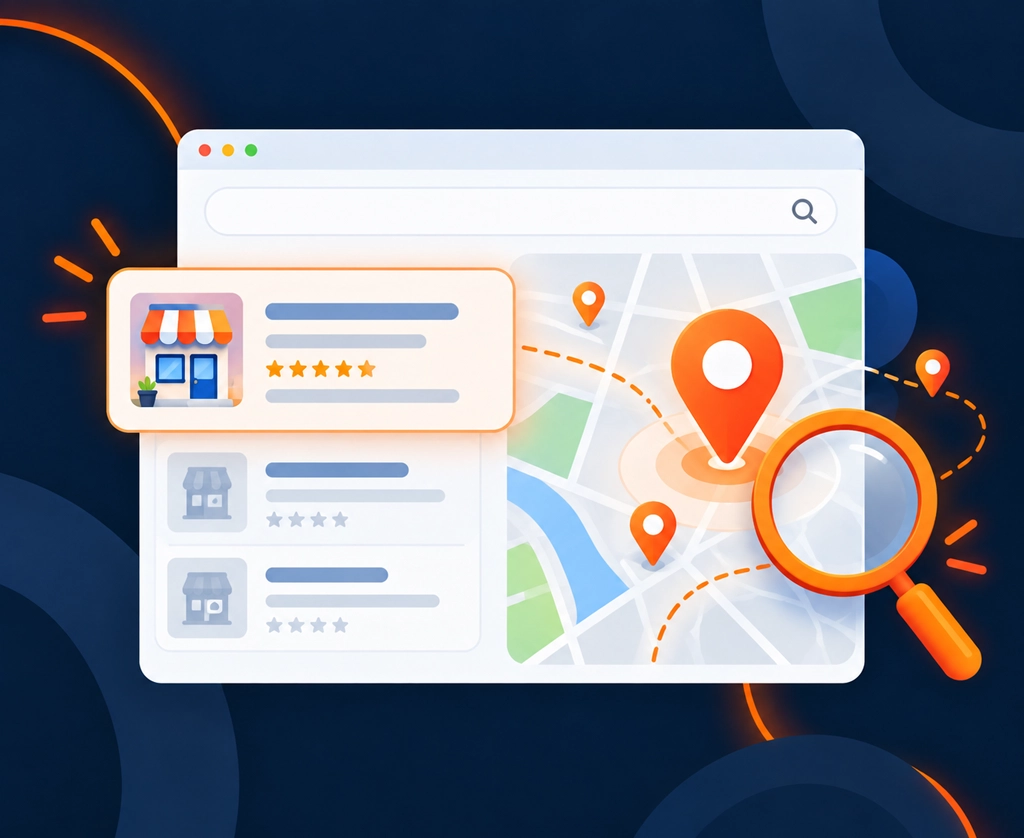
Google reviews can influence local visibility and customer trust. Here’s what matters and how to earn more genuine reviews.
Published

When somebody searches for a local business, Google reviews are often one of the first things they notice.
Before visiting a website or making an enquiry, they can see the business’s star rating, how many reviews it has and what previous customers think.
For businesses relying on customers from Google Search and Maps, that makes reviews particularly valuable.
But do Google reviews help SEO, or are they simply there to make your business look more trustworthy?
The answer is both.
Google confirms that more reviews and positive ratings can contribute to local search rankings. However, reviews are only one part of local SEO, and collecting more five-star ratings does not guarantee that your business will appear above its competitors.
There is also an important difference between collecting genuine customer feedback and trying to manipulate reviews for search rankings.
Here is what Google actually says, what reviews can influence and how businesses can build a stronger review profile without resorting to questionable tactics.
Yes. Google reviews can help improve local SEO.
Google’s official guidance explains that local search rankings are mainly influenced by three factors:
Reviews form part of the prominence picture.
Google explicitly states that having more reviews and positive ratings can help a business’s local ranking.
That makes reviews a genuine consideration for businesses targeting searches such as:
However, Google does not disclose exactly how much weight reviews carry within its local ranking systems.
A business with 200 reviews is not automatically going to outrank one with 50.
Location, relevance, business information, website quality and other prominence signals still matter.
Google explains these factors in its official local ranking guidance.
Reviews can contribute to local visibility in several ways, although some effects are better established than others.
Google confirms that the number of reviews a business has can contribute to its prominence.
This makes sense from a practical perspective.
A business with a substantial history of genuine customer feedback provides Google and potential customers with more information than one with almost no reviews.
That doesn’t mean you need hundreds of reviews before local SEO can work.
It means reviews are worth treating as an ongoing part of running the business rather than something to think about once every few years.
Google also confirms that positive ratings can contribute to local rankings.
But this should not be interpreted as a requirement to maintain a perfect five-star score.
Reviews naturally reflect different customer experiences.
Trying to prevent negative feedback or manipulate a rating is not a legitimate SEO strategy.
A business with honest reviews, thoughtful responses and a strong overall reputation is in a better position than one attempting to manufacture a perfect score.
This is arguably the most immediate commercial benefit.
Imagine somebody searches for a local service and sees three businesses offering something similar.
One has 12 reviews, another has 85 and the third has 160.
Review counts alone do not tell you which is best.
But customers are likely to consider the ratings, detail and credibility of that feedback before deciding who to contact.
Even if reviews did not influence search rankings, they could still affect how many enquiries a business receives from the visibility it already has.
There is little value in appearing prominently in Google if customers consistently choose the next business because its reputation looks more convincing.
Yes. Google reviews can contribute to the prominence signals used in local search, including Google Maps results.
This is particularly relevant when somebody searches for a nearby service.
Google may display a group of local businesses within its results, commonly referred to as the local pack.
These listings can show business names, ratings, review counts and other information from Google Business Profiles.
However, reviews are not the only determining factor.
A business that is far away from the searcher may struggle to appear above a more relevant nearby competitor, even if it has substantially more reviews.
Google cannot simply ignore geography because one business has a better star rating.
That is why a complete local SEO strategy also considers location, service relevance, website content and Business Profile optimisation.
We cover those wider factors in our local SEO guide for small businesses.
There is no published number.
Google does not say that reaching 25, 50 or 100 reviews unlocks better local rankings.
Any agency promising a particular position once you reach a certain review count is making a claim that Google’s public guidance does not support.
Instead, look at the actual businesses competing for the searches that matter to you.
For example, if you operate a garage in Huddersfield, review the Google Business Profiles of garages currently appearing for your important local searches.
Look at:
This provides useful competitive context.
It does not reveal Google’s algorithm, but it helps you understand how your reputation compares with businesses customers are already seeing.
We would encourage businesses to collect reviews consistently rather than attempting to gather a large number in one short campaign.
There are sensible reasons for doing this.
Recent feedback helps customers understand what the business is like today, rather than relying entirely on experiences from several years ago.
It also means the review profile can grow naturally alongside the business.
However, Google does not publish a formula confirming that receiving a particular number of new reviews each week provides a specific ranking improvement.
We would therefore avoid treating review frequency as a precise ranking target.
The objective should be to build an accurate, ongoing record of real customer experiences.
This is where a lot of questionable local SEO advice begins.
You may have heard that businesses should encourage customers to include particular keywords in their Google reviews.
For example, a web design agency might want reviews containing phrases such as:
Google can use information contained within reviews to understand and present themes associated with a business.
Its Business Profile documentation explains that recurring review language can contribute to features such as Place Topics and customer review snippets.
But that is not the same as Google confirming that inserting an exact keyword into a review will produce a ranking increase.
There is no reliable public formula establishing how many keyword mentions are needed or what ranking benefit each mention provides.
No.
Google’s review policies specifically prohibit businesses from requesting that particular content be included in customer reviews.
Asking ten customers to include the exact phrase “SEO agency Huddersfield” would therefore be the wrong approach.
The more sensible strategy is to let customers explain what they genuinely experienced, in their own words.
A detailed review might naturally mention website design, SEO, vehicle servicing, a particular product or another service.
That context can be useful for somebody researching the business.
But it should come from the customer rather than a keyword list supplied by the company.
You can read Google’s rules in its review content policy.
Getting more reviews does not need to involve complicated software or elaborate marketing campaigns.
For many small businesses, the biggest problem is simply that they rarely ask.
A customer may be delighted with the service and fully intend to recommend the business, but leaving a Google review is not necessarily something they remember to do afterwards.
Making the process straightforward can help.
One of the most natural opportunities is after a customer has received the product or service.
For a web agency, that might be after a website has launched.
For a garage, it could be after the vehicle has been collected.
For a retailer, it might be after an order has been delivered and the customer has had an opportunity to use the product.
The important thing is that the customer has genuinely experienced what they are being asked to review.
Don’t restrict requests to customers who have already told you they will leave five stars.
Google prohibits selectively soliciting only positive reviews.
Don’t expect customers to search for your business, locate the correct listing and work out how to leave feedback.
Google allows businesses to create a direct review link or QR code through Google Business Profile.
You can include that link in an email, WhatsApp message or other appropriate follow-up communication.
The fewer steps involved, the easier it is for customers who want to provide feedback.
Consistency is easier when requesting feedback becomes part of an existing workflow.
Depending on the business, that might mean:
There is no need to send repeated messages or pressure customers.
A polite request at a relevant point in the customer journey is usually enough.
A review request does not need to sound like a marketing campaign.
Something along these lines is sufficient:
“Thanks again for choosing us. If you have a moment, we’d really appreciate an honest Google review about your experience. Here’s the link if you’d like to leave one.”
Notice that this doesn’t ask for five stars, prescribe what the customer should say or offer anything in exchange.
It simply makes honest feedback easy.
Some businesses try to make the process easier by providing a complete review for customers to copy and paste.
We would avoid that.
A review should reflect the customer’s genuine opinion, expressed independently.
Supplying scripted wording, especially wording designed around specific SEO keywords, moves away from that principle.
It is better to let customers describe their experience themselves, even if the result is only two sentences.
A review request should not be the end of your involvement.
When somebody leaves feedback, read it.
Where appropriate, respond to it.
That shows existing and prospective customers that feedback is being taken seriously.
It also gives you an opportunity to address any genuine problems that have been raised.
Don’t treat reviews as a task that can be completed once.
A business should naturally develop new customer experiences over time.
Make requesting honest feedback part of the normal process and the review profile can continue to reflect the work the business is doing.
Google provides a straightforward way to generate a direct review link.
Google also allows you to generate a QR code from a desktop browser.
This can be useful for businesses that interact with customers in person.
For example, a local garage or shop could display the QR code where customers naturally receive their completed work or purchase documentation.
Google explains the process in its official review link and QR code instructions.
No.
Google prohibits incentivised reviews, including offering money, discounts, free products or services in exchange for reviews.
This also applies to incentives offered in exchange for changing or removing a negative review.
For example, offering a customer 10% off their next purchase if they leave a Google review is not an acceptable approach under Google’s policy.
Neither is offering a prize only to customers who leave a five-star rating.
There are also wider consumer protection obligations in the UK.
The Competition and Markets Authority has published guidance explaining businesses’ responsibilities around fake and misleading reviews under rules introduced in April 2025.
Read the CMA guidance on customer reviews if your business collects or publishes them.
Responding to reviews is good practice, but there is no need to manufacture a lengthy reply to every single comment.
Google recommends thoughtful, helpful responses that demonstrate you value customer feedback.
For a positive review, a simple acknowledgement may be enough.
For a detailed review, it may make sense to respond to something specific the customer mentioned.
For a negative review, the approach should be different.
Focus on understanding the complaint and addressing it professionally rather than arguing publicly.
Google has not publicly established that adding keywords to business-owner replies provides a specific local ranking boost.
So we would not recommend responding to every review with a paragraph repeating the same service keywords.
Respond because it is good customer service, not because an SEO checklist tells you to insert more search phrases.
Negative reviews are uncomfortable, particularly for smaller businesses where a single poor rating can have a noticeable effect on the overall score.
But trying to remove every negative review is rarely the right response.
If a customer has raised a genuine issue, acknowledge it and investigate what happened.
Keep the response professional and avoid sharing private customer information.
Where the issue cannot sensibly be resolved in public, invite the customer to contact the business directly.
Google allows businesses to report reviews that violate its policies.
However, simply disagreeing with a negative review does not make it eligible for removal.
The best long-term approach is to deal with legitimate complaints properly while continuing to provide a service customers are happy to recommend.
Displaying genuine customer reviews on your website can be useful, particularly from a conversion and trust perspective.
For example, somebody visiting a website after finding it in Google may feel more confident about making an enquiry when they can see feedback from previous customers.
Review widgets can also help visitors understand the experiences other people have had with the business.
However, displaying Google reviews on your own website does not automatically improve Google Maps rankings.
And there is an important structured data distinction.
Not necessarily.
Google’s review snippet guidelines state that businesses are generally ineligible for organic star review rich results when they control reviews about themselves on their own website.
This applies even when those reviews are displayed through a third-party widget.
For example, adding a Google Reviews widget to a local business homepage does not mean the business can use its own review rating to qualify for star snippets beneath that homepage in organic results.
This is separate from the ratings displayed on Google Business Profiles.
We would therefore display reviews because they help prospective customers assess the business, not because a plugin promises guaranteed star ratings in organic search.
You can read more in Google’s review snippet documentation.
Yes.
Fake reviews can create problems beyond simply being removed.
Google operates automated systems to identify suspicious and policy-violating contributions.
Its policies prohibit fabricated feedback, reviews that do not reflect real experiences, incentivised reviews and various forms of rating manipulation.
Businesses should also avoid reviewing themselves through alternative accounts or arranging misleading reviews through people with conflicting interests.
There are legal considerations too.
UK consumer protection rules prohibit various fake review practices, including commissioning fake reviews and misleading consumers through review information.
The sensible approach is straightforward: earn genuine reviews from genuine customers and let them express their own experiences.
Occasionally, a customer may tell you they have left a review, but it does not appear on your Business Profile.
Google uses automated systems to identify reviews that may violate its policies.
Reviews can also be delayed while checks take place.
Sometimes genuine reviews may be incorrectly removed by those systems.
If a review is missing, start by checking Google’s guidance rather than immediately assuming something is wrong with your website.
Avoid trying to resolve the issue by arranging duplicate reviews or encouraging the customer to create additional accounts.
Google provides further information in its guidance on missing and delayed reviews.
No. They serve different purposes and work best together.
Google reviews can help establish trust and contribute to local prominence.
Your website helps Google understand your services, expertise, content and relevance to particular searches.
For example, imagine a business has 150 excellent Google reviews but a website with almost no useful information about its services.
Those reviews may be valuable, but they do not replace the need for relevant service pages.
Likewise, a technically excellent website may struggle to persuade potential customers if the business has very little visible customer feedback.
A sensible local SEO strategy considers both.
There is no reliable way to attribute every ranking movement directly to an individual review.
Too many other factors can change at the same time.
However, you can monitor the overall relationship between reviews, visibility and customer enquiries.
Useful things to track include:
For example, a business might see its review profile improve alongside stronger visibility in Google Maps and more telephone enquiries.
That is useful information, but it is not proof that reviews alone caused every improvement.
Good SEO reporting should distinguish between what the data shows and what can reasonably be concluded from it.
If we were helping a small business establish a review process, we would keep it relatively simple.
There is no need to buy an expensive review management platform immediately.
For many small businesses, a consistent process using existing email or customer communication tools is enough to make a meaningful difference.
Google reviews deserve a place in local SEO because Google confirms that review quantity and positive ratings can contribute to local ranking performance.
They also help customers decide whether a business looks credible and worth contacting.
But there is no guaranteed review count, no magic star-rating threshold and no published formula proving that repeating keywords inside reviews will move a business up Google Maps.
Businesses are better served by providing good customer experiences, making it easy for customers to share genuine feedback and responding professionally.
Combine that with accurate business information, useful service pages, technical SEO and a sensible local search strategy.
That is a much more sustainable approach than attempting to manufacture review signals.
If your business relies on customers finding you through Google Search and Maps, reviews are only one part of the picture.
At Mello, we look at your existing website, Google Business Profile, local competitors, service pages and search performance to identify where the biggest opportunities are.
That might mean improving existing content, building stronger local landing pages, fixing technical issues or addressing weaknesses in the overall local SEO strategy.
Take a look at our SEO services or schedule a consultation to discuss your business.

WORK WITH US
Book a free consultation to talk through your website, SEO or online shop. No jargon, no obligation.
< Schedule a consultation >
Schedule an initial consultation to discuss your website, current challenges and plans for growth. You’ll receive clear, practical guidance without an unnecessary sales pitch.
Based in
Huddersfield, West Yorkshire
Availability
Working with clients UK-wide