Local SEO helps businesses get found by customers nearby. Here is what actually matters and where small businesses should focus first.
Published

For a local business, ranking nationally is often far less important than appearing in front of the right person a few miles away.
A garage in Huddersfield does not need somebody in Glasgow to find it.
A gym in Saddleworth does not need thousands of visitors from across the UK.
It needs people nearby who are actively looking for the service it provides.
That is where local SEO for small businesses comes in.
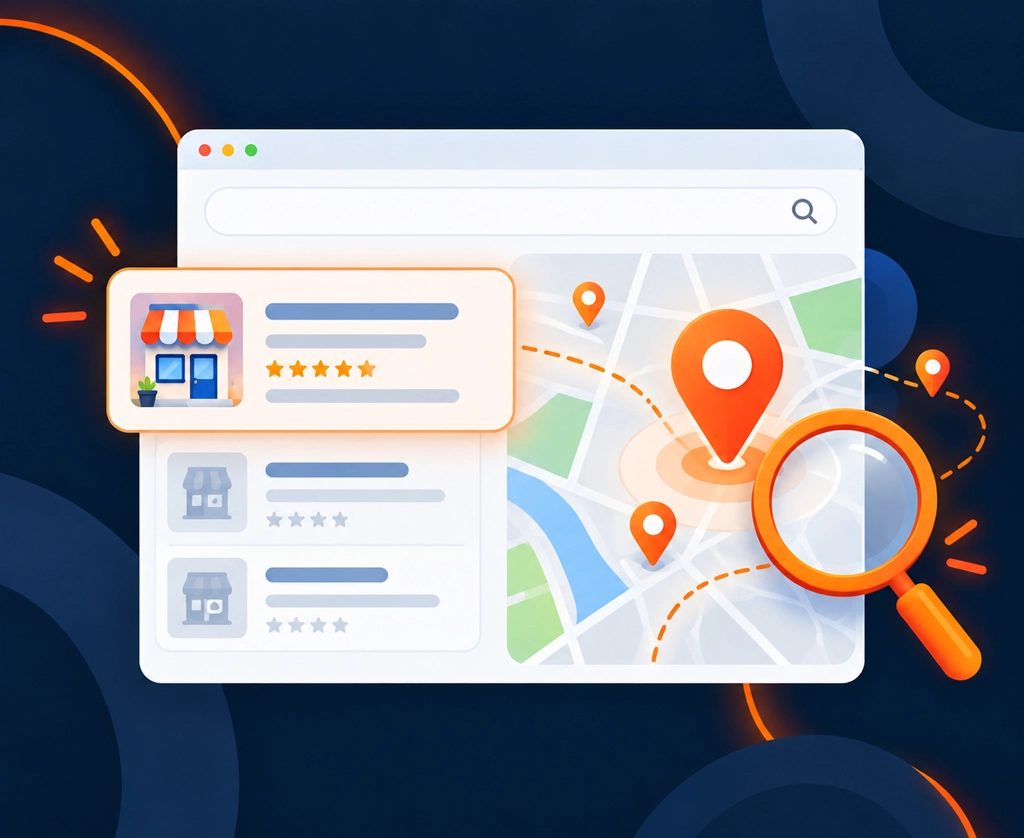
Local SEO is the process of improving how a business appears in location-based Google searches, including normal organic results, Google Maps and local business listings.
It is not a completely separate version of SEO. The same fundamentals still matter, including useful website content, technical performance, links and relevance.
The difference is that location becomes part of the search.
Local SEO focuses on searches where Google believes location matters.
Some searches make that obvious:
Others do not contain a place name at all.
If somebody searches for:
“car body repair”
Google can still use the searcher’s location to return nearby businesses.
This is why a business does not need to include a town name in every possible keyword for local SEO to matter.
Google explains local rankings using three main factors:
These factors work together.
Relevance is how closely a business matches what somebody is searching for.
If Google can clearly understand what your business does, what services you provide and where you operate, it has a better chance of matching you to appropriate searches.
This is influenced by information across your website and Google Business Profile.
For example, a garage website that clearly explains MOT testing, servicing, diagnostics and vehicle repairs gives Google much more useful information than one containing a homepage with three vague paragraphs.
Distance is exactly what it sounds like.
Google considers how far a business is from the person searching, or from the location mentioned in the search.
This is one part of local SEO that cannot simply be optimised away.
If somebody standing in central Manchester searches for a nearby plumber, a plumber in Huddersfield is unlikely to become the best result simply because their website has stronger SEO.
Location genuinely matters.
Prominence is broadly about how established and well known a business appears to be.
Google says this can be influenced by factors including:
This is why local SEO extends beyond simply changing a page title to include your town.
The underlying principles are similar, but the strategy can look very different.
National SEO usually focuses on competing across a much wider geographic area.
A national retailer or service provider might want visibility anywhere in the UK.
Local SEO focuses more heavily on:
For many small businesses, this makes local SEO a more sensible starting point.
There is little value in trying to outrank every competitor in the UK if most customers come from within twenty miles of the business.
For a genuine local business, Google Business Profile is one of the most important parts of local search visibility.
The profile can appear in Google Search and Google Maps and provides Google with direct information about the business.
That can include:
Google recommends keeping this information complete and accurate.
That sounds basic, but we regularly see profiles with incorrect opening hours, outdated websites, missing service information or categories that do not properly describe the business.
Your primary business category helps Google understand what the business actually is.
This can have a meaningful impact on the searches where the profile appears.
The category should describe the core business rather than every service it offers.
For example, a garage should normally select the most appropriate automotive business category rather than trying to use something vague because it covers more ground.
You can also add relevant secondary categories where they genuinely apply.
More categories are not automatically better.
Accuracy is more useful than trying to include everything available.
Google can source business information from your own website, your Business Profile and other publicly available sources.
That makes consistency important.
Your core business information should ideally match wherever it appears:
This is sometimes referred to as NAP consistency, meaning name, address and phone number.
It does not mean every mention across the internet has to be formatted identically down to punctuation.
It means Google should not be finding conflicting versions of the business.
Google Business Profile is important, but it does not replace the website.
Google can use information it finds on your website to understand what the business does and how relevant it is to local searches.
Your website also gives you much more space to explain individual services.
A good local website should make it obvious:
If somebody lands on the website from Google Maps, the site still needs to turn that visibility into an enquiry.
Where location is genuinely relevant to the page, yes.
A local service page might reasonably target something such as:
SEO Huddersfield
or:
Car Body Repairs Wakefield
That does not mean adding ten nearby towns into the same title.
The title should still describe the actual page.
A title such as:
Plumber Huddersfield Leeds Halifax Wakefield Bradford Yorkshire
does not create a stronger page simply because it contains more locations.
It normally makes the result worse for users and gives Google very little clarity about what the page is specifically targeting.
Sometimes.
Location pages can work well when a business genuinely serves several distinct areas.
For example, a company might operate throughout:
A properly developed page for each important location can help explain the services available in that area.
The mistake is producing dozens of pages where only the town name changes.
Pages such as:
Web Design Huddersfield
Web Design Halifax
Web Design Wakefield
should not be identical pages with find-and-replace location names.
Each page should exist because there is a real search opportunity and enough useful information to justify it.
A local landing page should still be a useful page first.
Depending on the business, that might include:
The page should give somebody a reason to choose the business rather than simply prove that the location name can be repeated several times.
Yes, reviews matter.
Google explicitly says that more reviews and positive ratings can contribute to local prominence.
But reviews are useful for more than rankings.
They also affect whether somebody actually chooses the business after seeing it in search results.
A business with a strong rating and recent, detailed feedback can appear much more credible than a competitor with three reviews from four years ago.
Good review management should therefore involve:
We will cover this separately in our guide to whether Google reviews help SEO.
A citation is simply a mention of your business information elsewhere online.
Examples can include:
These can help reinforce that the business exists and is associated with a particular location or industry.
But quantity is not the objective.
Submitting a business to hundreds of poor-quality directories is not automatically good local SEO.
We would rather see accurate listings on genuinely relevant websites than a huge spreadsheet of low-quality directory links nobody uses.
Links still matter in local SEO.
A local business can often earn relevant links through relationships that already exist.
That might include:
A relevant local link can provide both SEO value and genuine referral traffic.
That is normally more useful than buying a large quantity of unrelated links solely because somebody has given them an impressive-looking metric.
Internal linking matters for local SEO just as it does for wider organic search.
If an important local service page is buried several levels deep and nothing on the website links to it, Google has fewer signals showing that the page matters.
Relevant pages should connect naturally.
For example:
This also makes the website easier for customers to navigate.
Structured data can help Google understand factual information about a business.
Google supports LocalBusiness structured data, which can describe information such as:
It is useful where appropriate, but it is not a local ranking shortcut.
Adding schema does not make an irrelevant business suddenly rank above a genuinely relevant nearby competitor.
Think of it as helping Google understand accurate information rather than as a trick for improving positions.
Not every local business has a shop or office customers visit.
Tradespeople, mobile services and businesses that travel to customers can operate as service-area businesses.
The same broad local SEO principles still apply.
The website should clearly explain:
The temptation is to claim an enormous service area because technically the business could travel there.
That does not necessarily create meaningful local relevance.
Focus on the areas where you realistically want customers.
No.
This is one of the most common mistakes in local SEO.
A company serves twenty towns, so twenty near-identical pages are created.
That can result in thin content, duplication and pages that provide very little value.
Start with locations that meet at least one of these conditions:
You can always expand later.
They can, but publishing local content purely for the sake of it is rarely useful.
You do not need weekly articles called:
“Why Huddersfield Businesses Need Websites”
or:
“Top Five Reasons to Choose a Huddersfield SEO Agency”
unless those articles genuinely answer something customers are searching for.
Blogs are more useful when they support wider topical authority and customer questions.
For example, a local garage might publish information about:
The local relevance comes from the business itself and the website structure, not from inserting the town name into every blog title.
A local SEO audit is simply a structured review of the factors affecting a business’s local visibility.
We would normally look at areas such as:
The useful part is not receiving a score out of 100.
It is identifying which weaknesses are actually preventing the business from competing locally.
Local SEO should be measured using more than one metric.
Useful indicators include:
Rank tracking also needs context.
A local keyword can produce different results depending on where the person searching is physically located.
That means checking a single ranking from one location does not always tell the full story.
There is no fixed answer.
A small business in a lightly competitive local market may see movement relatively quickly.
A business trying to compete in a large city against established competitors may take considerably longer.
The starting position matters too.
A verified Business Profile, established website, good reviews and relevant service pages provide a very different starting point from a brand-new business with almost no online presence.
If you want a broader view of timescales, we have explained what a realistic first six months can look like in our guide to how long SEO takes to work.
Most local SEO problems are not particularly glamorous.
Common examples include:
Fixing these basics can often create more value than chasing obscure local SEO tactics.
Yes.
A small business owner can make significant improvements without hiring an agency.
If you are starting from scratch, I would prioritise:
That is a much stronger starting point than purchasing a generic “100 local citations” package.
Paying for local SEO makes sense when organic and local search have enough commercial value to justify ongoing work.
For example, if one new customer is worth several thousand pounds and Google is a common way people find businesses like yours, improving local visibility can be commercially significant.
Professional support can also make sense when:
If you are trying to understand typical investment levels, our guide to SEO pricing in the UK explains what different budgets can realistically cover.
A small business does not need to rank everywhere.
It needs to rank in the places where the right customers are searching.
That usually means being selective.
Understand the services worth promoting, the locations worth targeting and what customers actually search before creating pages or spending money on SEO.
From there, the fundamentals are fairly straightforward:
Local SEO becomes much easier to prioritise when it is treated as part of the wider business rather than as a collection of ranking tricks.
If your business relies on customers from a particular town, city or service area, we can look at how you currently appear across Google Search and Maps.
We will identify where the main opportunities are, what is holding the website back and which locations are genuinely worth targeting.
Take a look at our SEO services or schedule a consultation to discuss your website.
WORK WITH US
Book a free consultation to talk through your website, SEO or online shop. No jargon, no obligation.
< Schedule a consultation >
Schedule an initial consultation to discuss your website, current challenges and plans for growth. You’ll receive clear, practical guidance without an unnecessary sales pitch.
Based in
Huddersfield, West Yorkshire
Availability
Working with clients UK-wide