Google Search is changing quickly. Here is what AI Overviews mean for rankings, website traffic and the SEO work businesses should focus on.
Published

Google Search is changing.
Instead of every search leading to a familiar list of blue links, Google can now generate an answer directly within the search results using AI Overviews.
For businesses that have spent years investing in SEO, that naturally raises some uncomfortable questions.
Will people still click websites? Can a business optimise for AI Overviews? Does traditional SEO still matter? And if Google can answer a question itself, is there any point creating content in the first place?
The short answer is that SEO is still very much relevant, but the type of content that earns visibility is becoming increasingly important.
Google’s own guidance is fairly clear: there is no separate trick for ranking in AI Search. Strong technical SEO, genuinely useful content, clear website structure and first-hand expertise remain the foundations.
What is changing is how Google uses that information and how people interact with the results.
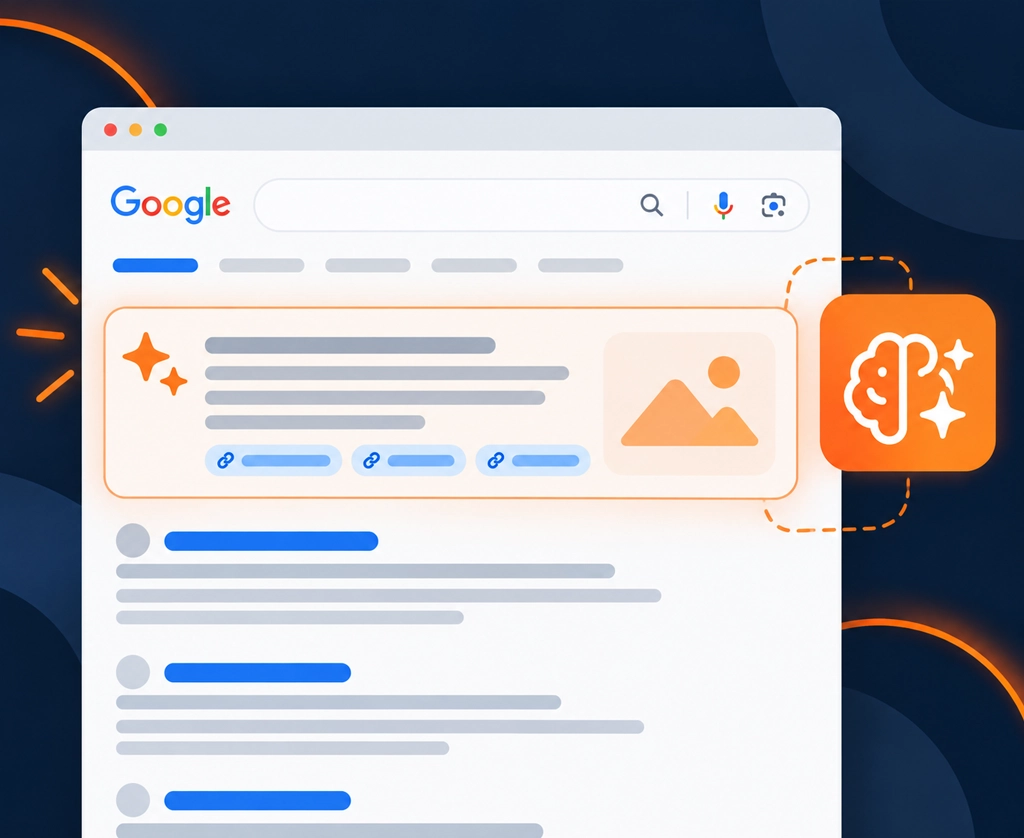
Google AI Overviews are AI-generated summaries that can appear within Google Search.
Instead of simply displaying a list of websites, Google can bring information together from multiple sources and generate an answer to the user’s question.
The Overview can then include links to websites that support or expand on different parts of the answer.
They are particularly useful for searches that require explanation, comparison or information from several different sources.
For example, somebody searching:
“What should I look for when choosing an SEO agency for a small manufacturing business?”
might receive an AI-generated answer covering experience, reporting, technical SEO, industry knowledge and contract terms, alongside links to websites that Google considers relevant to those individual points.
That is quite different from a traditional search where Google simply decides which ten pages should rank from first to tenth.
AI Overviews and AI Mode are related, but they are not exactly the same thing.
An AI Overview appears within a normal Google search result when Google’s systems believe an AI-generated summary would be useful.
AI Mode is a more conversational search experience where users can ask longer questions, explore a subject and continue with follow-up questions.
Google has increasingly connected the two experiences, allowing users to move from an AI Overview into a deeper AI conversation.
From an SEO perspective, the important point is that both still use information from Google’s search index and link back to websites.
Google describes its AI search systems as being rooted in its existing Search ranking and quality systems.
Not completely.
Traditional organic listings, local results, products, images, videos and other Google features still exist alongside AI-generated results.
AI Overviews also do not appear for every search.
Google says they are shown when its systems believe an AI response adds something useful to the normal search experience.
That means the impact varies considerably depending on what somebody searches for.
A question such as:
“What is the difference between website hosting and a domain?”
is much easier for Google to summarise directly than:
“web design agency Huddersfield”
The second search has commercial and local intent. The person is looking for an actual business rather than simply an explanation.
This distinction matters.
Informational content is likely to feel the impact of AI-generated answers more heavily than many high-intent commercial searches.
This is where the answer becomes less straightforward.
Google says that overall organic click volume from Search has remained relatively stable and that clicks generated through its AI experiences can be higher quality because users who do visit a website often have a clearer reason for doing so.
Google also says people are asking more searches and increasingly using longer and more complicated queries.
However, independent research has found that individual searches containing an AI Overview can generate fewer website clicks.
A Pew Research Center study found that users clicked a traditional search result on 8% of searches where an AI summary appeared, compared with 15% where one did not.
Research from Ahrefs has also found substantially lower click-through rates for top-ranking organic pages when an AI Overview is present.
Both things can potentially be true.
Google can be sending a similar overall number of clicks across billions of searches while individual informational keywords generate fewer clicks than they once did.
For businesses, this means rankings alone are becoming an increasingly incomplete measure of SEO performance.
Yes.
Google’s official guidance explicitly says that SEO remains relevant to its generative AI search features.
AI Overviews and AI Mode still depend heavily on Google’s existing search infrastructure to discover, understand and retrieve information from websites.
If Google cannot crawl a page, understand it or include it in its normal Search index, that page is not suddenly going to become more visible because AI has been added to Search.
In fact, many of the things that make a page strong for traditional SEO also make it a useful source for AI-generated results.
Google does not publish a formula that allows a website owner to guarantee inclusion in an AI Overview.
It has, however, explained some of the technology behind the process.
One important technique is retrieval-augmented generation.
Rather than relying entirely on what an AI model already knows, Google can retrieve current information from its Search index and use those sources to help generate its response.
Google can also use what it calls query fan-out.
This means a complicated question can effectively be broken into several related searches behind the scenes.
For example, somebody might ask:
“Is WordPress or Shopify better for a small UK business selling personalised products?”
Google may investigate related subjects such as:
It can then use information retrieved across those areas to build the final response.
This creates an interesting SEO opportunity.
A website does not necessarily need to contain one enormous article attempting to answer every possible variation of a topic.
What matters more is having genuinely useful pages that clearly demonstrate expertise across the subjects your business actually knows about.
There is no single AI Overview optimisation switch.
The sensible approach is to strengthen the same things that make a website useful and understandable in Search generally.
This sounds obvious, but it remains the starting point.
A page needs to be eligible for normal Google Search before it can be used as a supporting result within Google’s generative AI features.
That means checking the basics:
AI Search has not removed the need for technical SEO.
This is probably becoming more important rather than less.
If twenty websites all contain essentially the same generic explanation, an AI system has very little reason to value the twenty-first version.
Google’s current guidance specifically encourages what it calls non-commodity content.
In practical terms, that means publishing things based on real knowledge and experience rather than simply rewriting what already exists online.
For Mello, an article explaining what makes a good website would be more useful if it included observations from actually designing and rebuilding business websites.
A generic list saying websites should be “fast, modern and responsive” adds very little.
A discussion of why we sometimes recommend repairing an existing website rather than replacing it entirely comes from real experience and gives the reader something less interchangeable.
Useful content does not need to be unnecessarily complicated.
If somebody asks how much website design costs, the page should actually discuss price.
If somebody asks whether SEO is worth paying for, the content should address return, timescales and commercial value rather than spending 1,000 words explaining what SEO stands for.
Clear headings, sensible paragraphs and direct explanations make content easier for people to use.
They also make the relationships between different sections of a page clearer to search systems.
Businesses have an advantage here that generic content publishers often do not.
You have customers, projects, processes, results, mistakes, opinions and practical experience.
Use them.
Examples can include:
This kind of information is harder to reproduce than another generic article assembled from ten existing search results.
Google specifically continues to recommend making important content easily discoverable through internal links.
Internal links help users move between related subjects and help search engines understand how those subjects fit together.
For example, this article naturally belongs within a wider SEO topic cluster.
Someone reading about AI Search may also want to understand how our SEO service works or how long SEO realistically takes to produce results.
The objective is not to insert twenty keyword-rich links into every article.
It is to make related information genuinely easy to discover.
Google’s AI search experiences are increasingly multimodal.
That means Search is not limited to understanding written paragraphs.
Images and video can also provide useful context and create additional opportunities for visibility.
That reinforces the importance of using relevant original imagery where possible, sensible filenames, appropriate alt text and surrounding content that explains what the visual actually represents.
Structured data can still help Google understand specific information on a website and make pages eligible for certain Search features.
However, there is no special “AI Overview schema” that suddenly makes a website appear in AI Search.
Google says structured data should continue to match what is actually visible on the page.
The normal rule applies: use structured data where it genuinely describes the content, not because somebody has sold it as an AI ranking shortcut.
For local businesses, Google Business Profile information remains important.
For eCommerce businesses, product information supplied through Google Merchant Center can also be used across Google’s search experiences.
AI Search has not made these existing Google ecosystems irrelevant.
If anything, keeping accurate structured business and product information becomes more useful as Google tries to answer increasingly detailed questions.
No.
This is one of the clearer pieces of current guidance from Google.
Google Search does not require an llms.txt file to understand or include a website in AI Overviews or AI Mode.
Adding one will not improve or damage visibility within Google Search.
Other AI platforms may choose to use such files, but it is not a Google ranking requirement.
If somebody tells you an llms.txt file is essential for appearing in Google’s AI results, that is not supported by Google’s current documentation.
Again, no.
There is currently no special Schema.org markup required for Google AI Overviews.
Normal structured data can still be valuable where appropriate, but adding invented “AI optimisation” markup is not a shortcut into AI-generated answers.
Not simply for the sake of it.
Google specifically warns against rewriting everything into an artificial format purely because somebody believes an AI system prefers it.
You may have seen recommendations to turn every paragraph into tiny “AI-friendly chunks”, create separate pages for every possible question or repeatedly phrase answers in a certain way.
Google says that is unnecessary.
Search systems can understand meaning, related concepts and synonyms without every page matching the exact wording of a search.
The priority should remain writing something that makes sense to the person reading it.
Using AI does not automatically make content bad for SEO.
Google’s concern is the value of the finished content rather than whether software helped create it.
AI can be useful for research, structure, brainstorming and improving workflows.
The problem appears when businesses generate hundreds of pages with little review, originality or purpose purely to capture search traffic.
That can fall into Google’s policies around scaled content abuse.
Whether a piece of content was drafted using AI or written manually, somebody should still be responsible for its accuracy, usefulness and relevance.
Potentially, yes.
This is something businesses need to accept rather than pretend is not happening.
If somebody searches for a simple fact and Google gives them the complete answer immediately, there may be no reason for them to click a website.
That makes some informational traffic less valuable than it appeared historically.
But it also reinforces an important SEO principle:
Traffic itself was never the real objective.
A website attracting 20,000 visitors who never become customers is not necessarily performing better than one attracting 2,000 highly relevant visitors who regularly enquire.
Businesses should increasingly look beyond total organic sessions and ask what search visibility is contributing commercially.
An AI summary can explain something quickly.
It cannot always replace the experience behind the information.
People still visit websites when they want:
This is where business websites can continue to add value beyond an AI-generated summary.
We would not respond by publishing more content.
We would respond by being more selective about what gets published.
For years, SEO encouraged businesses to create large numbers of relatively generic informational articles because even fairly basic content could attract search traffic.
AI Overviews make that strategy less attractive.
Instead, content should sit closer to genuine customer questions and business expertise.
For example, a web agency probably does not need another generic article called:
“10 Benefits of Having a Website”
There are thousands of versions of that information already available.
A more useful article might explain:
“Why We Sometimes Tell Businesses Not to Redesign Their Website”
That has an opinion, practical experience and a reason to exist beyond filling a content calendar.
For a local business, we would not suddenly abandon traditional local SEO because AI Overviews exist.
Commercial searches still depend heavily on local relevance, Google Business Profiles, reviews, service information, location signals and strong landing pages.
A plumber, garage, accountant or web designer still needs Google to understand:
Those fundamentals remain useful regardless of whether the search result contains an AI-generated element.
The same principle applies to online retailers.
Accurate product information, clear categories, strong product pages, Merchant Center feeds, reviews, imagery and technical SEO continue to matter.
AI Search may change how somebody researches a product, but the customer still needs somewhere to view it, evaluate it and purchase it.
For eCommerce businesses, AI Search is more likely to change parts of the discovery journey than eliminate the website itself.
This has improved significantly during 2026.
Google Search Console now provides dedicated reporting for visibility within Google’s generative AI search features.
The report covers impressions generated through features such as AI Overviews and AI Mode, giving website owners a clearer view of whether their content is appearing within Google’s AI experiences.
Google completed the worldwide rollout of these generative AI performance reports in August 2026.
If you use Search Console, this is therefore worth adding to your normal SEO reporting alongside:
The important thing is not to create a completely separate “AI SEO” reporting universe.
AI visibility is becoming another part of how people discover businesses through Search.
Businesses should pay attention to them, but panic is not useful.
Search has changed repeatedly over the years.
Featured snippets, local packs, shopping results, knowledge panels, video results and instant answers have all changed what a Google results page looks like.
AI Search is a bigger change than many of those features, but the core challenge remains familiar.
Google wants information it can trust and users want useful answers.
A business that has a technically sound website, genuinely understands its subject and publishes useful first-hand information is in a much stronger position than one trying to exploit the latest optimisation trick.
You may increasingly hear terms such as:
GEO, meaning Generative Engine Optimisation, and AEO, meaning Answer Engine Optimisation.
There can be useful discussions behind those labels, particularly when analysing how brands appear across different AI systems.
But Google’s own position is straightforward.
For Google Search, optimising for generative AI search is still SEO.
The same underlying search systems, technical foundations and quality signals continue to matter.
That may evolve further, but businesses do not currently need to throw away everything they understand about SEO and replace it with an entirely new discipline.
If we were reviewing a website specifically with AI Search in mind, we would start with the fundamentals rather than looking for AI hacks.
We would ask:
Those are all things we would have recommended before AI Overviews existed.
The difference is that Google’s ability to understand, summarise and reuse information is becoming much more sophisticated.
Google AI Overviews will continue to change how people use Search.
Some informational searches will generate fewer website clicks. New types of queries will emerge. Search journeys will become more conversational and measuring visibility will become more complicated.
But websites have not suddenly stopped mattering.
Google still needs information to retrieve. Customers still need businesses to research. Products still need somewhere to be purchased. Services still need somewhere to be explained. Businesses still need credibility.
The companies most likely to struggle are not necessarily those that fail to discover a secret AI optimisation technique.
They are the ones producing interchangeable content that gives Google and the customer very little reason to choose them over anybody else.
If you are trying to understand how changes such as AI Overviews affect your existing SEO strategy, we can review where your website currently stands and what is realistically worth improving.
Our approach still starts with the same fundamentals: understanding what your customers search for, building the right pages, fixing technical problems, improving useful content and measuring whether the work contributes to the business.
Take a look at our SEO services or schedule a consultation to discuss your website.
WORK WITH US
Book a free consultation to talk through your website, SEO or online shop. No jargon, no obligation.
< Schedule a consultation >
Schedule an initial consultation to discuss your website, current challenges and plans for growth. You’ll receive clear, practical guidance without an unnecessary sales pitch.
Based in
Huddersfield, West Yorkshire
Availability
Working with clients UK-wide